History: How we got to modern AI (a friendly timeline)
You do not need history to use AI, but it can make the whole thing feel less mysterious. This section explains - in plain English - how we got from early computers to today's chat-style AI.
A simple timeline
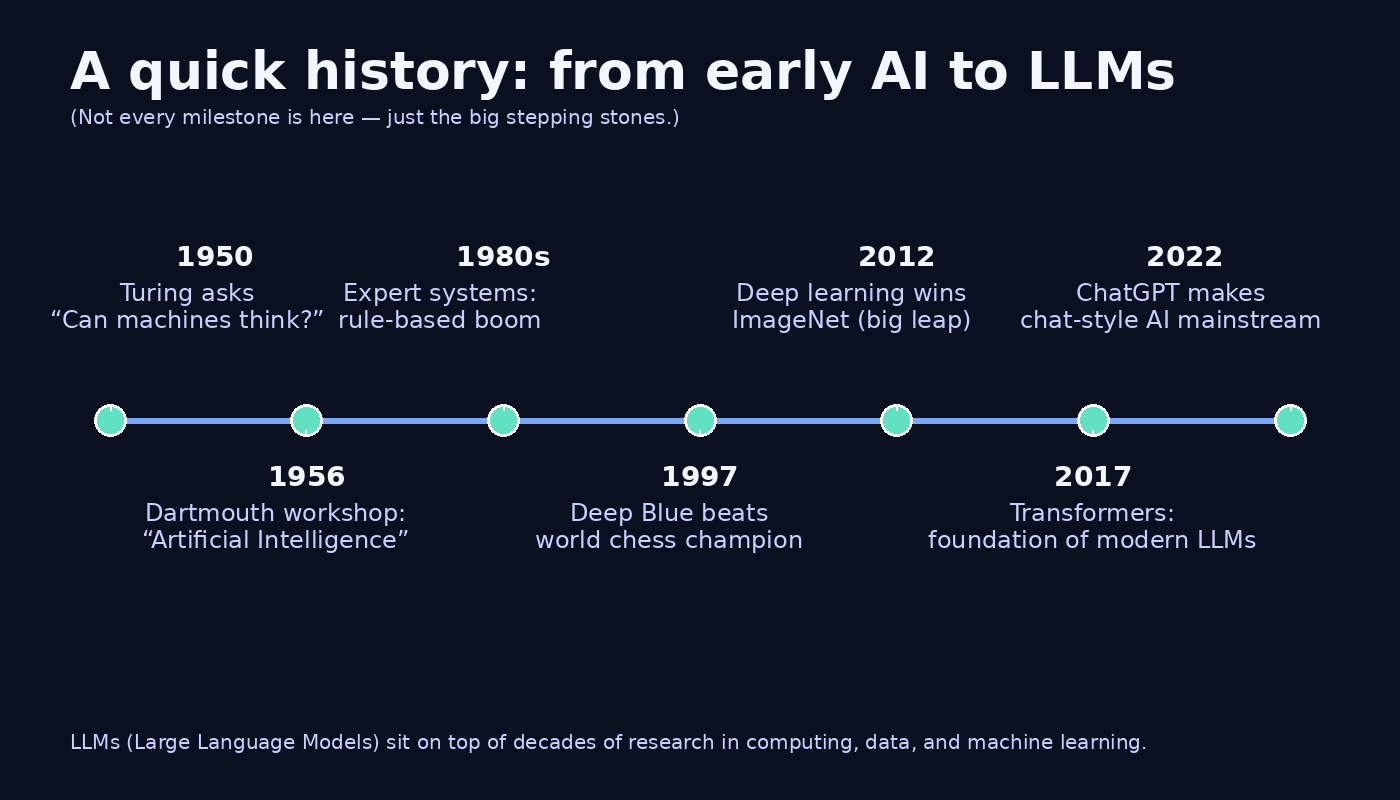
This timeline is not every event in AI history - just the milestones that help explain why chatbots suddenly became so good.
1950s: Early ideas and the perceptron
In the 1950s, researchers began exploring whether machines could 'learn'. One early idea was the perceptron - a simple model inspired by how a neuron might work.
1970s-1980s: Expert systems
For a while, many AI systems were 'expert systems': humans wrote rules like 'IF X THEN Y'. These worked in narrow domains, but they struggled with messy real-world language.
1990s-2000s: Better data and better statistics
As more text became available digitally, computer systems improved at finding patterns in language using statistical methods. This was a big step forward, but the systems still struggled with flexible conversation.
2010s: Deep learning takes off
In the 2010s, deep learning became more practical thanks to large datasets and powerful computer chips. Neural networks became much better at recognising patterns in images, speech, and text.
2017: Transformers
A major breakthrough in language AI was the Transformer architecture. Transformers helped models handle context better and scale to much larger sizes.
2020: Very large language models
Large language models grew dramatically in size and capability. This made them much better at writing, summarising, translating, and answering questions.
2022: ChatGPT popularises chat-style AI
Chat-style interfaces made AI feel accessible to everyday people. Instead of learning special software, you could simply talk to it.
Why this matters for beginners
- These tools did not appear overnight. They are built on decades of research.
- They are powerful, but they are not magical. They generate language based on patterns.
- They can be helpful assistants, but they are not perfect sources of truth.
A gentle takeaway
The best way to learn is still the simplest: use AI for small tasks, practise good prompts, and keep safety habits. In other words: curiosity plus common sense.
Screenshots